
Following Damascus … Museum Folkwang explores the interconnections between Islamic art and European modernism
With the exhibition Following Damascus … Karl Ernst Osthaus and the Arts of the Islamicate World (6 November 2026 to 21 Febuary 2027), Museum Folkwang is, for the first time, devoting a comprehensive exhibition to the former “Islamic Department” and its legacy within the modern Folkwang universe. Around 340 objects – ranging from ceramics and textiles to metalwork and glassware – provide an insight into the acquisition policy of the museum’s founder, Karl Ernst Osthaus (1874–1921), illustrating his perspective on the art of the Islamicate world.
m 1898 onwards, even before paintings by Auguste Renoir or Vincent van Gogh found their way into the Museum Folkwang’s collection, Osthaus gathered applied arts dating from the 4th to the 19th centuries on his travels through North Africa and West Asia, thereby laying the foundations for the “Islamic Department” of the early Folkwang Museum. His travels took him to Syria, amongst other places, and had a significant influence on his self-image as an art collector and on the development of the Folkwang concept. As a result, an “Islamic Department” emerged in Hagen and found its final form in 1919, ranking among the first museum collections of Islamic art in the German-speaking world.
Following Damascus … brings together historical artefacts with new perspectives and highlights the diverse interconnections between Islamic art, European modernism and contemporary art.
The exhibition traces Osthaus’s travels around 1900 and charts the development of the collection through key stages and significant events. Key milestones include early acquisitions in the Maghreb and the Ottoman Empire as well as Museum Folkwang’s participation in the groundbreaking Munich exhibition Masterpieces of Muhammedan Art in 1910. Selected documents also provide an insight into the changes in the presentation of the collection during the First World War and the further development of the collection in Essen following Osthaus’s death.
The exhibition is complemented by loans of former works from Museum Folkwang. These include, amongst others, the precious 17th-century manuscript of a Persian Shāhnāma (Book of Kings), which is now housed in Berlin and is rarely shown in public. A beam from the so-called Damascus Room, which is now in Dresden, is also coming to Essen and will be presented as a key artefact in the history of the collection.
The exhibition centres on the question of how Islamic art was perceived, presented and related to European art and design in the early Folkwang context. The historical objects enter into a cross-disciplinary dialogue with works by European artists and designers, including a painting by Henri Matisse, a fabric design by Peter Behrens, mosaic designs by Johan Thorn Prikker and an architectural project by Bruno Taut. Photographs from the Folkwang publishing house’s circle illustrate just how diverse the museum’s collection, interests and networks were right from the outset. One focus is on the relationships between the ornamentation of Islamic textiles and architectural ceramics and modern design. The historical perspective is complemented by a contemporary work by the Palestinian-Saudi artist Dana Awartani. Her work offers a contemporary perspective on the historical collection and exhibition concepts whilst simultaneously highlighting their Eurocentric perspectives.
Supported by the Art Mentor Foundation Lucerne, the Karin and Uwe Hollweg Foundation, the Cultural Foundation of the German Federal States, the Ernst von Siemens Art Foundation and the Art Foundation North Rhine-Westphalia.
Research and restoration
The exhibition is the result of extensive research undertaken by Museum Folkwang since 2019 to catalogue the collection of its former “Islamic Department”. Thanks to generous funding from the State of North Rhine-Westphalia, the objects have been restored and conserved since 2022.
Publication
The exhibition is accompanied by a comprehensive catalogue. Around 28 essays explore the context of the exhibition in greater depth and situate Museum Folkwang’s collection within the context of national and international museum practice.
Information
FOLLOWING DAMASCUS …
Karl Ernst Osthaus and the Arts of the Islamicate World
6 November 2026 to 21 Febuary 2027
Press preview: Wednesday, 4 November 2026, 11 a.m.
Opening: Thursday, 5 November 2026, 7 p.m.
Admission: €14 (standard) / €10 (concessions)
Tickets: www.museum-folkwang.ticketfritz.de
Opening hours
Tuesday to Sunday, 10 a.m. – 6 p.m.; Thursday and Friday, 10 a.m. – 8 p.m.
Closed on Mondays
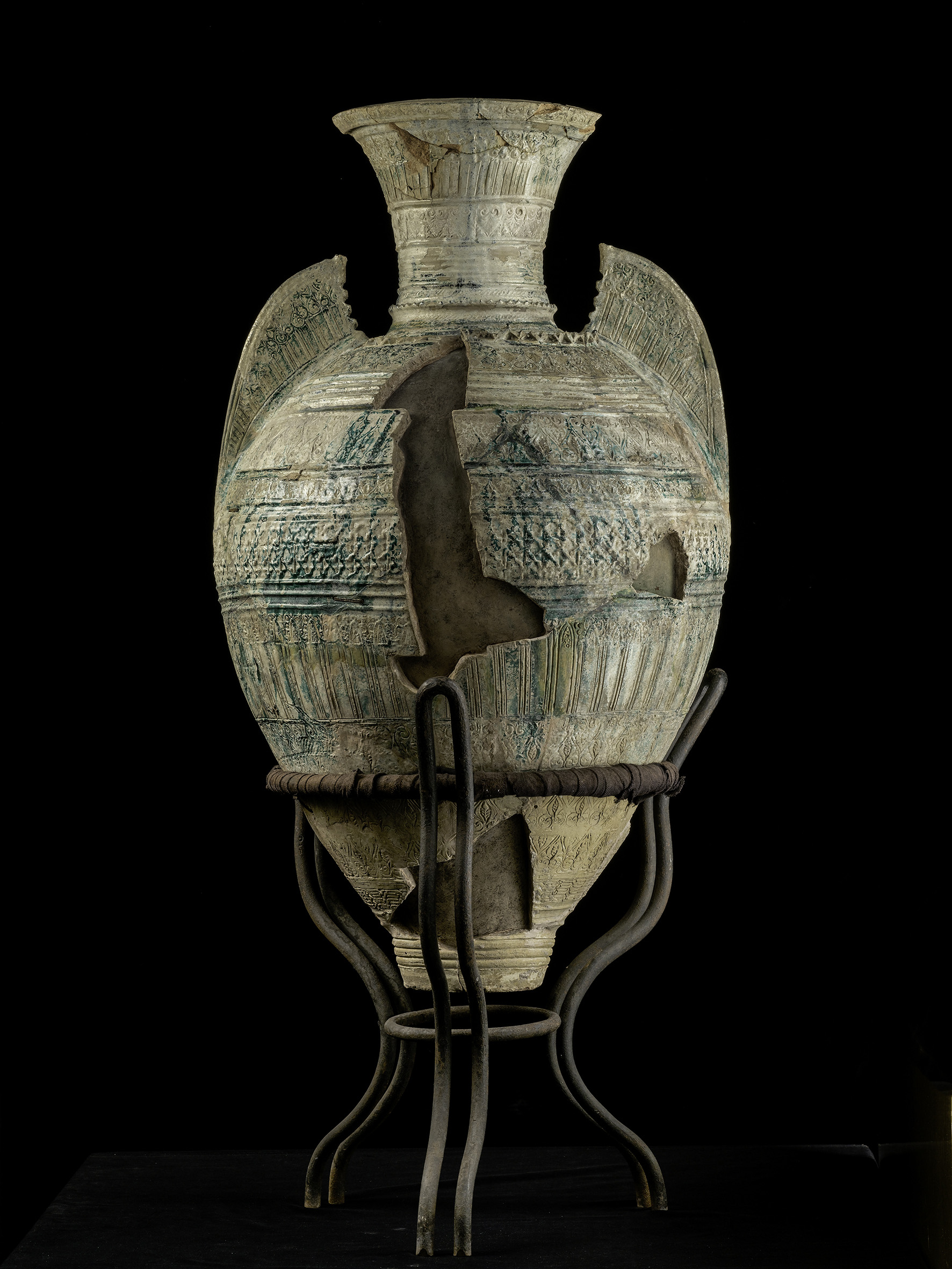
Vase (jarrón, fragment)
second half of the 12th century – first half of the 13th century
Seville
Eathenware, glazed, relief decoration with stamped impressions
129 × 60 cm
Museum Folkwang, Essen
© Photo: Hans Hansen, Hamburg
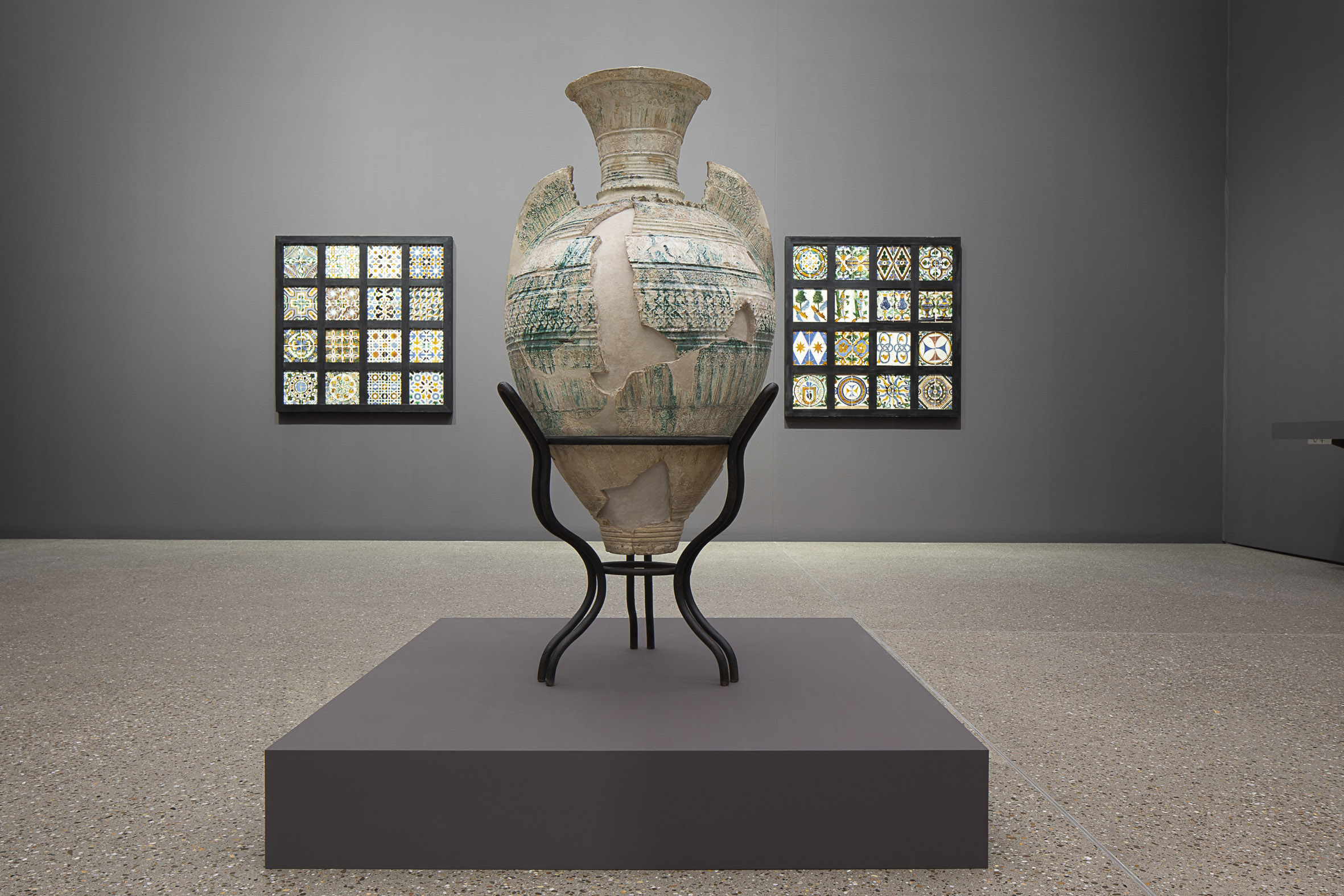
Installation view of Following Damascus featuring a vase (jarrón), fragment
2026
Photo: Julia Reschucha, Museum Folkwang

Dana Awartani
Come, Let Me Heal Your Wounds. Let Me Mend Your Broken Bones (Installation view), 2024
14 silk panels
415 × 1000 × 297
© Dana Awartani, Courtesy the Artist and Lisson Gallery
Foto: Museum Folkwang, Julia Reschucha
Share on

Vase (jarrón, fragment)
second half of the 12th century – first half of the 13th century
Seville
Eathenware, glazed, relief decoration with stamped impressions
129 × 60 cm
Museum Folkwang, Essen
© Photo: Hans Hansen, Hamburg

Dana Awartani
Come, Let Me Heal Your Wounds. Let Me Mend Your Broken Bones
2024
Installation view
14 silk panels
415 × 1000 × 297 cm
© Dana Awartani, Courtesy the Artist and Lisson Gallery, London Photo: Julia Reschucha, Museum Folkwang

Exhibition view: ‘Following Damascus …’ with vase and tiled panels
2026
Photo: Julia Reschucha, Museum Folkwang, Essen